Where are Bridgestone tyres made, and does the country matter?
Quick answer
Bridgestone tyres are made in plants around the world, including Japan, Thailand, Indonesia, India, China, Europe and the Americas. The country is moulded on the sidewall, and the plant code follows the letters DOT. Bridgestone builds each pattern to one company-wide standard, so the DOT date and how the tyre was stored matter more than its origin.
Key takeaways
- Most Bridgestone tyres sold in the UAE that we fit come from plants in Japan, Thailand and Indonesia, but other origins are normal too.
- The country is moulded on the sidewall as Made in, and the two or three characters after DOT identify the exact plant.
- A given pattern and size is built to the same specification wherever it is made.
- The DOT date, storage conditions and correct load and speed rating matter far more for UAE drivers than the country of manufacture.
When I turn a new tyre round to show a customer the DOT date, the next question is often about the small print beside it: why does this say Made in Thailand, I thought Bridgestone was Japanese? It is a reasonable thing to ask. Bridgestone is a Japanese company, founded in Kurume in 1931, but like every large tyre maker it builds tyres in many countries, close to the markets they serve.
This post explains where Bridgestone tyres come from, how to read the origin and plant code on your own sidewall, and why I tell customers to worry far more about the date code than the country. If you want the full breakdown of the four-digit date itself, see how to read a Bridgestone DOT date code.
Where are Bridgestone tyres made?
Bridgestone makes tyres in dozens of plants across Asia, Europe and the Americas, with Japan as its home base. Its Asian production includes plants in Thailand, Indonesia, India and China, and it also builds tyres in several European countries and in North and South America.
The tyres that reach the UAE come mainly from the Asian plants, because of shipping distance and because many sizes and patterns sold here are produced there. On the vans, the sidewalls I read most often say Japan, Thailand or Indonesia. Larger European-developed sizes for premium cars sometimes come from European plants.
The same size of the same pattern can come from more than one plant over its life, depending on demand. So two Turanza tyres in the same size bought a year apart may carry different country markings, and that is normal.
How can you tell where your Bridgestone tyre was made?
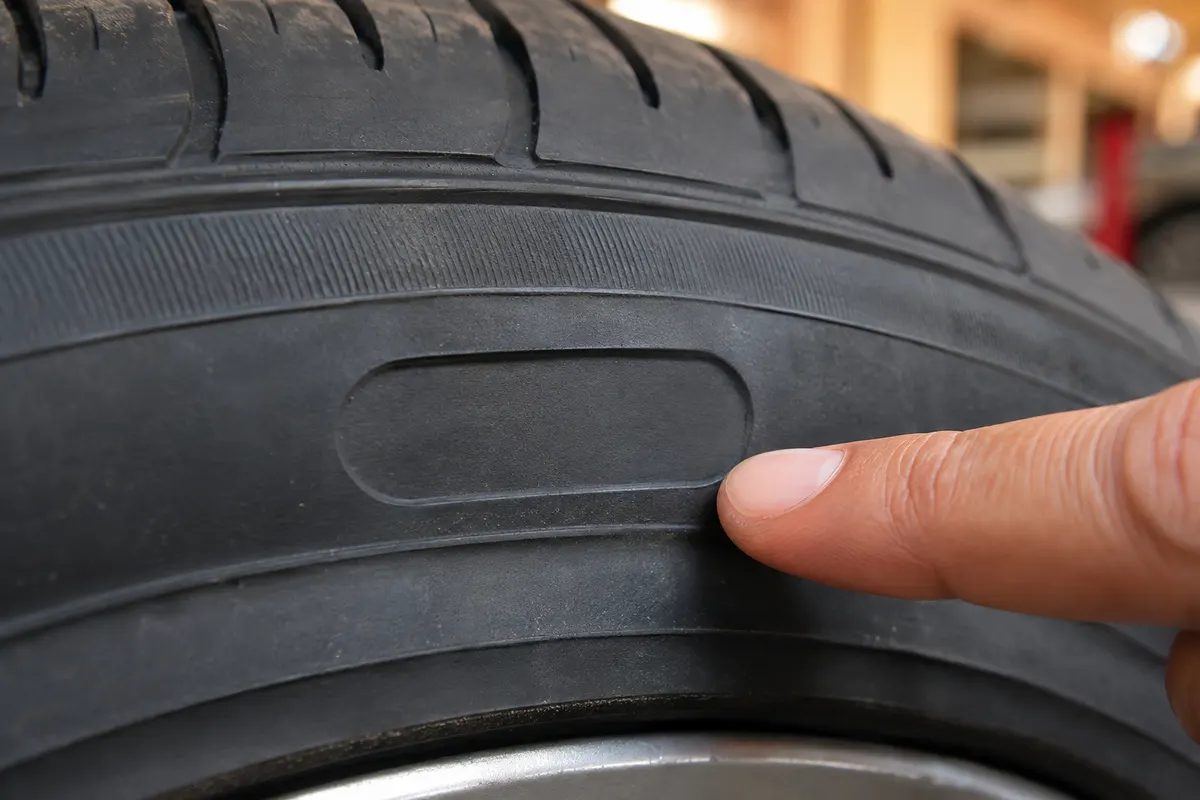
The country of manufacture is moulded on the sidewall in plain English, usually as Made in followed by the country name. It is normally near the size marking or the DOT code, in small raised letters, and on most tyres you will find it on at least one side.
The DOT code tells you the exact plant. It starts with the letters DOT, followed by a plant code of two or three characters, then a size code, an optional manufacturer code and, at the end, the four-digit date. The plant codes are issued by the US road safety regulator, NHTSA, which publishes the list, so any plant code can be looked up.
The four-digit date is the part that matters most for you. 2426, for example, means week 24 of 2026. If a seller cannot show you this number before fitting, ask why.
| Part | Example | What it tells you |
|---|---|---|
| DOT | DOT | The tyre meets US Department of Transportation standards |
| Plant code | AB | The factory that made the tyre (two or three characters) |
| Size code | CD | The manufacturer's internal code for the size |
| Manufacturer code (optional) | EFG | Internal construction or batch details |
| Date code | 2426 | Week 24 of 2026; the most important number for you |
| Made in | Made in Thailand | Country of manufacture, moulded separately on the sidewall |
Is a Japanese-made Bridgestone better than one made in Thailand or Indonesia?
A Bridgestone pattern in a given size is built to the same design and specification whichever plant makes it, under one company-wide quality system. A Turanza or Dueler made in Thailand is the same tyre as one made in Japan, carrying the same load index, speed rating and construction.
I understand why people prefer Made in Japan; it has a strong reputation, and Bridgestone's research base is there. But in four years of fitting and removing tyres in the UAE I have not seen a pattern of failures linked to the country of manufacture. The problems I see come from age, pressure and damage.
If you specifically want a Japanese-made tyre, you can ask us when we quote, and we will tell you what the current stock shows for your size. Sometimes it is available, sometimes it is not, and the tyre you get will be equally sound either way.
Why are some Bridgestone patterns only made in certain regions?
Some Bridgestone patterns are developed for particular regions, so they are built in the plants that serve those markets. Patterns aimed at Asian and Middle East markets, such as the Bridgestone Ecopia EP150, are typically produced in Asian plants.
The Turanza family is a good example of regional variation. The Bridgestone Turanza T005A is a version of the Turanza line common in Asian and Middle East sizes, often seen on Japanese and Korean sedans, while other Turanza patterns cover sizes popular on European cars.
This is why the pattern name matters more than the country. When you choose a tyre, choose the right pattern and size for your car first; where it was made follows from that.
Does country of manufacture matter for UAE drivers?
Country of manufacture matters very little for UAE drivers compared with the tyre's age and how it was stored before it reached your car. A fresh tyre from any Bridgestone plant will cope with 60–70°C road surfaces and 140 km/h on the E11 if it is correctly rated and inflated.
Where origin can matter indirectly is the supply chain. Tyres that have travelled through several traders, or sat in a hot container and then an unventilated warehouse, can arrive older and more heat-aged than their DOT date suggests. That is about the route, not the factory.
The practical rule I give customers: ask for the date first, check the size, load index and speed rating second, and only then, if you still care, ask about the country.
What matters more than where the tyre was made?
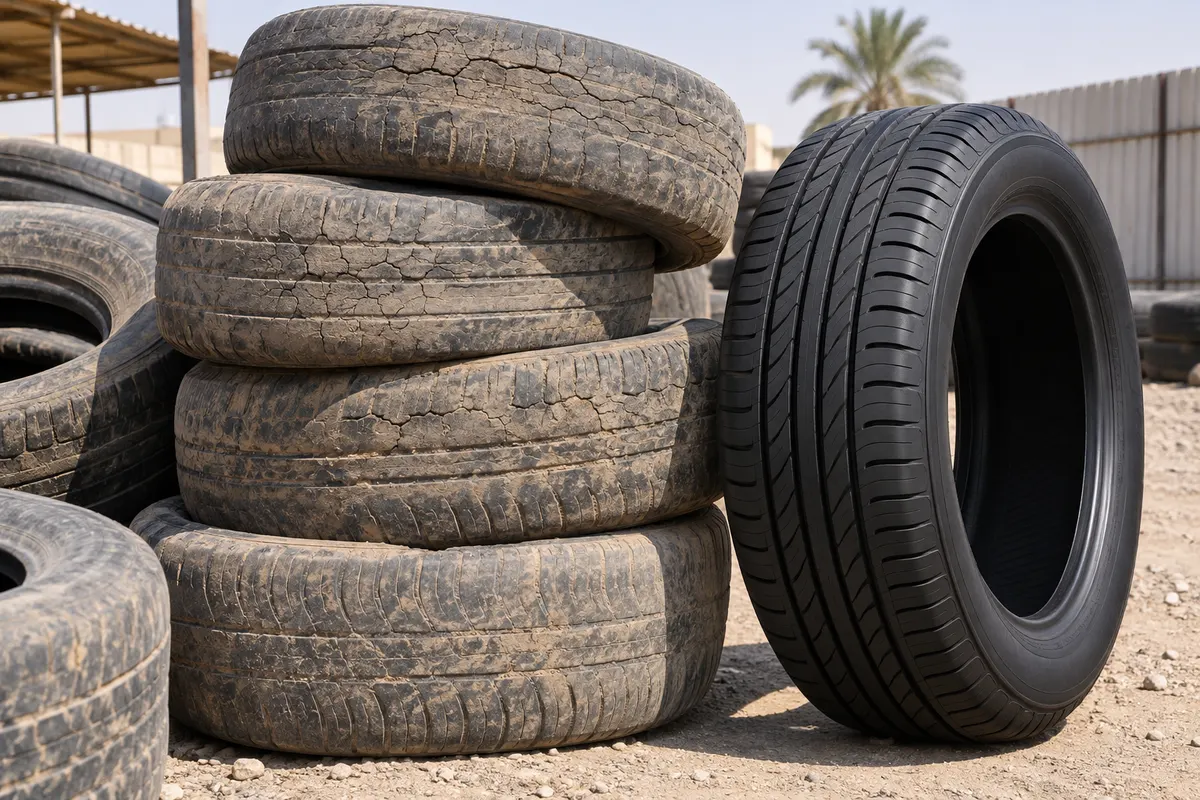
The DOT date is the single most important thing to check on a new tyre in the UAE. I prefer tyres under 12 months old, and tyres more than five years past their DOT date are commonly rejected at inspection. Rubber ages even unused, and heat speeds that up.
Storage is the second factor. A tyre kept indoors, out of direct sun and away from heat sources, ages slowly; a tyre stacked outside a shop in August does not. If you see tyres displayed in the sun, that tells you something about the seller.
The third factor is fit: the right size, load index and speed rating for your car, mounted, balanced and inflated properly. Our guide on how to spot old or fake Bridgestone tyres covers the warning signs in more detail.
- Check the four-digit DOT date before fitting.
- Match size, load index and speed rating to your door placard or current tyre.
- Avoid tyres stored in direct sun.
- Look for clean, sharp moulding on the sidewall lettering.
How do we handle origin and date when we fit your tyres?
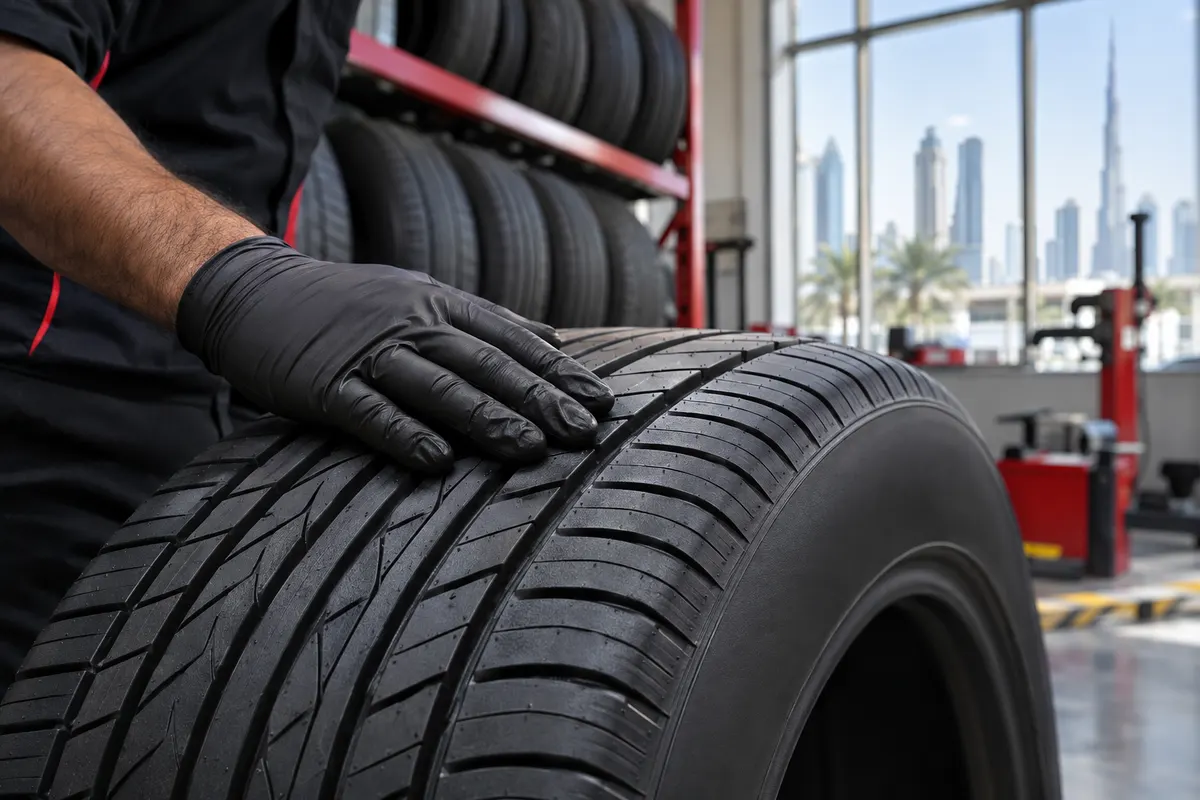
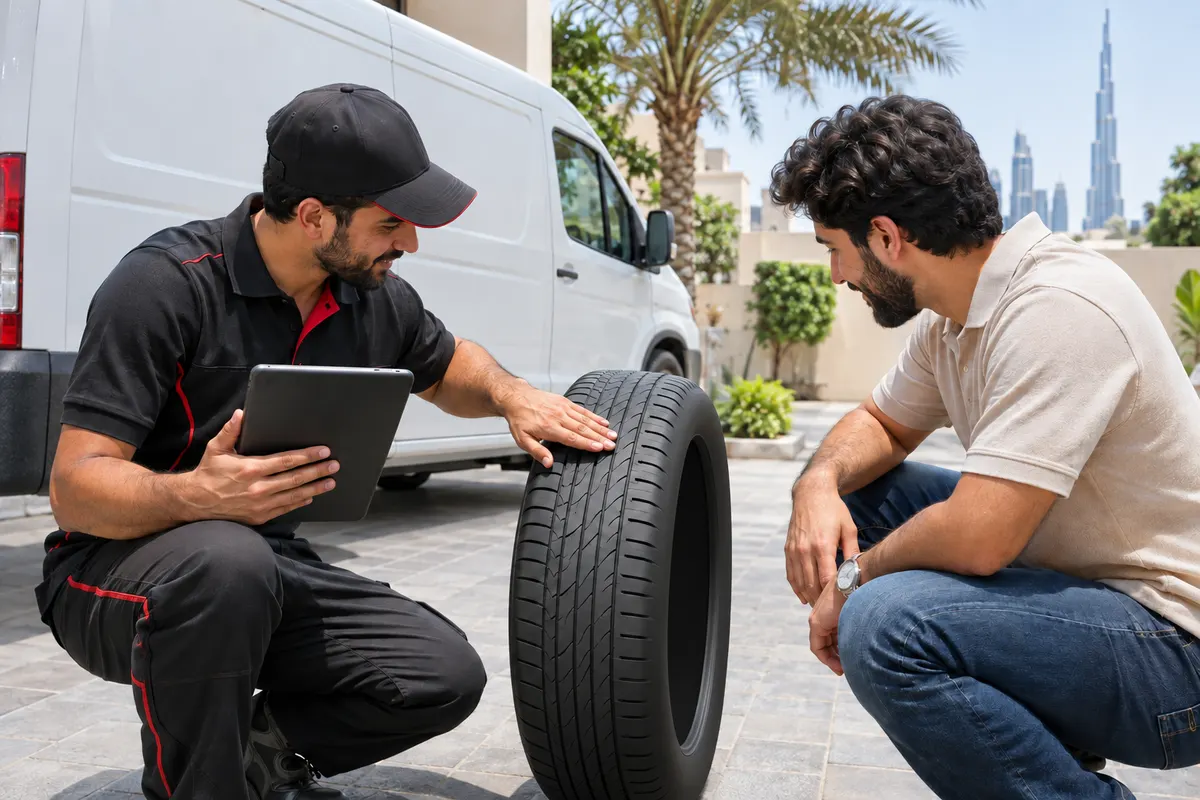
Before every fitting, our technician shows you the DOT date and the sidewall markings of each new tyre, including the country of manufacture. If anything does not match what you were quoted, you can refuse the tyre before it goes on the wheel.
Popular Bridgestone sizes are in stock, and other sizes are usually sourced the same or next day. When we confirm your quote on WhatsApp, or you check prices on the Bridgestone tyres Dubai page, we can tell you the DOT date of the stock we hold, and the origin if you ask for it.
Fitting includes removal, mounting, a new valve, balancing on the van, torque to spec and pressure set to the door placard. You can see the full process on our new tyres service page.