Bridgestone Tyre Pressure Guide for the UAE: Summer, Highway and Sand
Quick answer
The correct Bridgestone tyre pressure is the figure on your car's door placard, set cold before driving; most sedans and SUVs fall between 30 and 38 PSI. In UAE heat, pressure rises about 1 PSI for every 5–6°C, so never let air out of hot tyres. For sand, air down to 15–18 PSI and reinflate before tarmac.
Key takeaways
- Use the pressure on the driver's door placard, not the maximum moulded on the Bridgestone sidewall.
- Check cold, before driving: a hot tyre can read 3–5 PSI higher after a highway run.
- Pressure changes about 1 PSI for every 5–6°C, so a tyre set in August reads low on a cool January morning.
- For soft sand, 15–18 PSI is a common starting point; reinflate to the placard before returning to the road.
If I could change one habit for every driver in the UAE, it would be checking tyre pressure properly. Most of the worn shoulders, cracked sidewalls and summer failures I deal with on the vans trace back to tyres that were a few PSI low for months. The fix costs nothing but a gauge and two minutes, as long as you check at the right time and use the right number.
This guide covers the correct pressure for your Bridgestone tyres, why the reading must be taken cold, how much UAE heat moves it, whether nitrogen is worth paying for, and how to air down safely for the dunes. If you would rather have it done for you, our tyre pressure check comes to your parking space from AED 100.
What is the correct Bridgestone tyre pressure for my car?
The correct pressure for any Bridgestone tyre is set by your car maker, not by Bridgestone, and it is printed on the placard inside the driver's door frame. The same tyre size can need different pressures on different cars, because the figure depends on the vehicle's weight, balance and suspension.
The number moulded on the sidewall, often 44 or 51 PSI, is the maximum the tyre can safely hold. It is not a recommended setting, and running at that figure makes the car skittish and wears the centre of the tread.
Many placards give two sets of figures: one for normal use and one for full load or sustained high speed. If you are heading to Oman with five people and a full boot, use the full-load figure. Some cars also list different front and rear pressures, and XL tyres may have their own line. Our Bridgestone tyre size guide explains what XL means and why it changes the pressure.
Why should you check tyre pressure cold?
Placard pressures are cold pressures, meaning the tyre has not been driven more than a couple of kilometres and has stood for at least three hours. As soon as you drive, the air inside warms up and the reading climbs, so a hot reading is not comparable with the placard figure.
After 30 minutes on the E311 in summer, a tyre can easily read 3–5 PSI above its cold figure. A driver who checks at that point and lets air out to match the placard has just left the tyre under-inflated for the rest of the day.
The best time to check in the UAE is early morning, before the car has moved and before the sun reaches it. If you have to check at a petrol station after driving, add air only if the hot reading is below the placard, and recheck properly the next morning.
| Vehicle type | Examples | Typical placard range | Notes |
|---|---|---|---|
| Hatchback and small sedan | Yaris, Sunny, Accent | 30–35 PSI | Use the loaded figure for long trips |
| Mid-size sedan | Camry, Accord, Altima | 32–36 PSI | Most common placard range |
| Performance car | BMW 3 Series, Mustang | 32–38 PSI | Front and rear often differ |
| Mid-size SUV | RAV4, X-Trail, Tucson | 33–36 PSI | XL tyres may need more |
| Large SUV and 4x4 | Land Cruiser, Patrol, Tahoe | 30–38 PSI | Raise to the full-load figure when loaded |
| Electric car | Tesla Model 3, Model Y | 40–42 PSI | Heavier cars, higher placard figures |
| Van and light commercial | Hiace, Urvan | 45–65 PSI | C-type tyres, rear usually higher |
| 4x4 in soft sand (temporary) | Any 4x4 on A/T tyres | 15–18 PSI | Reinflate before tarmac |
How much does UAE heat change tyre pressure?
Tyre pressure changes by roughly 1 PSI for every 5–6°C change in temperature. That sounds small until you put UAE numbers on it: the difference between a 15°C January morning and a 40°C August morning is about 25°C, or 4–5 PSI.
In practice this means a tyre set correctly in the summer will read low by the time winter arrives, and the TPMS light often comes on during the first cool mornings of December. The opposite also applies: tyres set on a cool morning will read higher by afternoon, which is normal and not a reason to let air out.
Sun matters as well as air temperature. A car parked in direct sun on a 45°C day can have one side reading noticeably higher than the side in shade. This is why I always take the reading before the sun gets to the car, and why steady pressure matters so much for avoiding the failures described in how to prevent tyre blowouts in UAE summer.
Should you change tyre pressure for UAE summer?
You should not lower tyre pressure for UAE summer; keep it at the cold placard figure all year. Some drivers let a few PSI out in July thinking it prevents blowouts, but an under-inflated tyre flexes more, builds more heat and is more likely to fail on a hot highway.
If you regularly drive long distances at 120–140 km/h with passengers and luggage, use the placard's full-load or high-speed figure if it has one. Do not go above the maximum on the sidewall, and do not raise pressures well beyond the placard to save fuel, because grip and braking suffer.
On a heavy SUV such as a Lexus LX or a Land Cruiser on Bridgestone Alenza 001 tyres, the difference between the normal and full-load figure is often a few PSI. It is a small adjustment that makes a real difference to how the tyres cope with a family road trip in August.
Nitrogen vs air in Dubai: is nitrogen worth it?
Nitrogen keeps tyre pressure more stable than compressed air, but it does not replace regular checks. Normal air is already about 78% nitrogen; filling with nitrogen mainly removes the oxygen and moisture, so the pressure leaks away a little more slowly and swings a little less with heat.
For UAE drivers the practical benefit is fewer surprises between checks, especially for people who drive long distances in summer or rarely look at their tyres. It will not stop a tyre losing pressure through a puncture, a leaking valve or a damaged bead.
If your tyres already have nitrogen and you need a top-up, adding ordinary air is safe; it simply dilutes the benefit. Our pressure check visits, from AED 100, include a nitrogen or air top-up to the placard, a look at tread and sidewalls, and a valve check, and the van can reach you around the clock through our 24-hour tyre service in Dubai.
What tyre pressure should you use for sand driving?
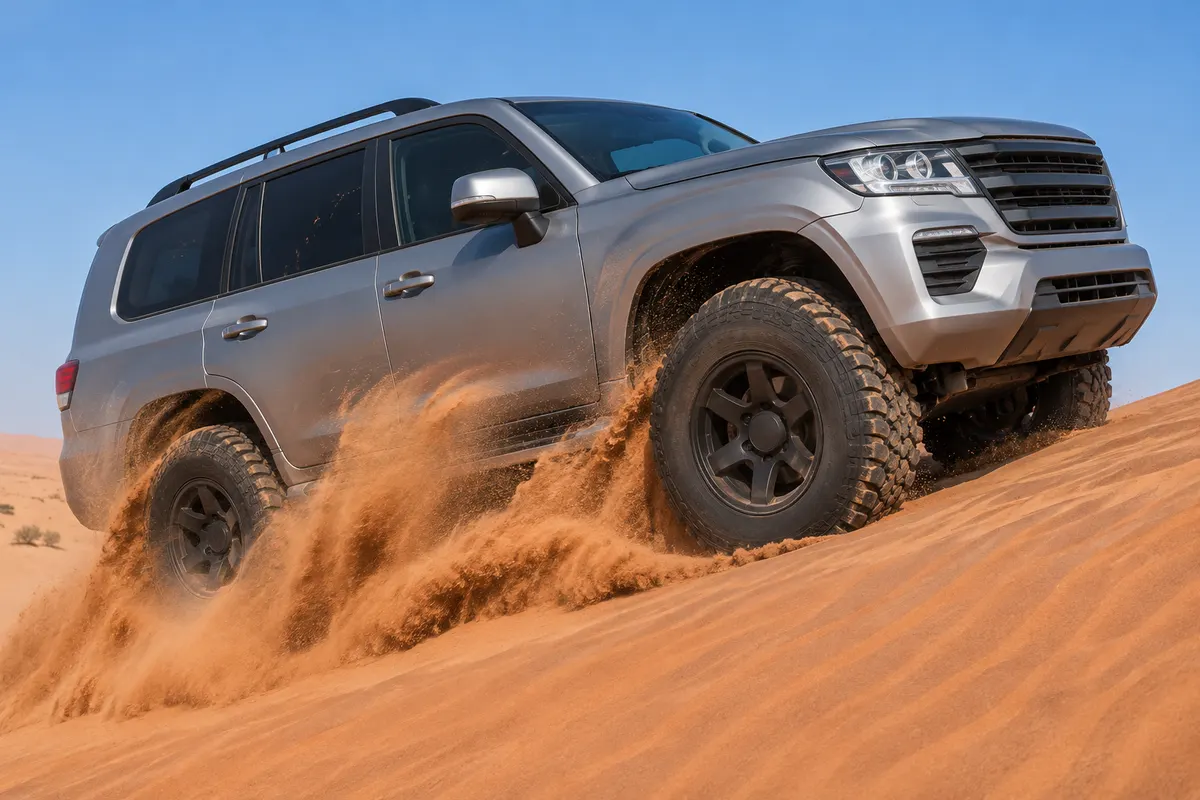
For soft sand in places like Al Qudra, Fossil Rock or Liwa, 15–18 PSI is a common starting pressure for most 4x4s on all-terrain tyres. Lower pressure lengthens the tyre's footprint so it floats on the sand instead of digging in, which is what keeps you moving up a dune face.
Experienced drivers sometimes go lower for very soft sand, but below about 15 PSI the risk of pulling a tyre off the rim in a sharp turn rises quickly. All-terrain patterns such as the Bridgestone Dueler A/T 002 have sidewalls designed to cope with aired-down use, but they still need care.
Follow a simple routine:
- Air down at the edge of the sand, all four tyres to the same figure, using a proper gauge
- Keep speeds low and avoid sharp turns at full lock on soft sand
- Expect the TPMS warning; it is normal at sand pressures
- Reinflate to the placard with a compressor before driving on tarmac
- Never drive at highway speed on aired-down tyres; the sidewalls overheat within kilometres
What does a TPMS warning mean?
A tyre pressure monitoring system (TPMS) warning means at least one tyre has dropped well below its set pressure, usually by around 20% or more. Treat it as a prompt to check all four tyres with a gauge, not as a reading in itself.
A warning on the first cool morning of the season, which goes away once the tyres warm up, is usually just temperature. A warning that returns days after a top-up points to a slow leak, often a nail in the tread or a corroded valve. A flashing light, on many cars, means a sensor fault rather than low pressure.
Sensors have batteries that typically last several years, and they can also be damaged during careless tyre changes. If yours has stopped reporting, we can test and replace it on site through our TPMS sensor replacement service.
How often should you check tyre pressure in the UAE?
Check tyre pressure at least once a month in the UAE, and before every long trip or desert outing. Tyres lose a small amount of pressure naturally, often around 1 PSI a month, and the seasonal temperature swing adds to that.
Include the spare. A full-size spare on a Prado or Patrol is often found 15–20 PSI low when it is finally needed, which on a hot hard shoulder of the E11 is the last thing you want.
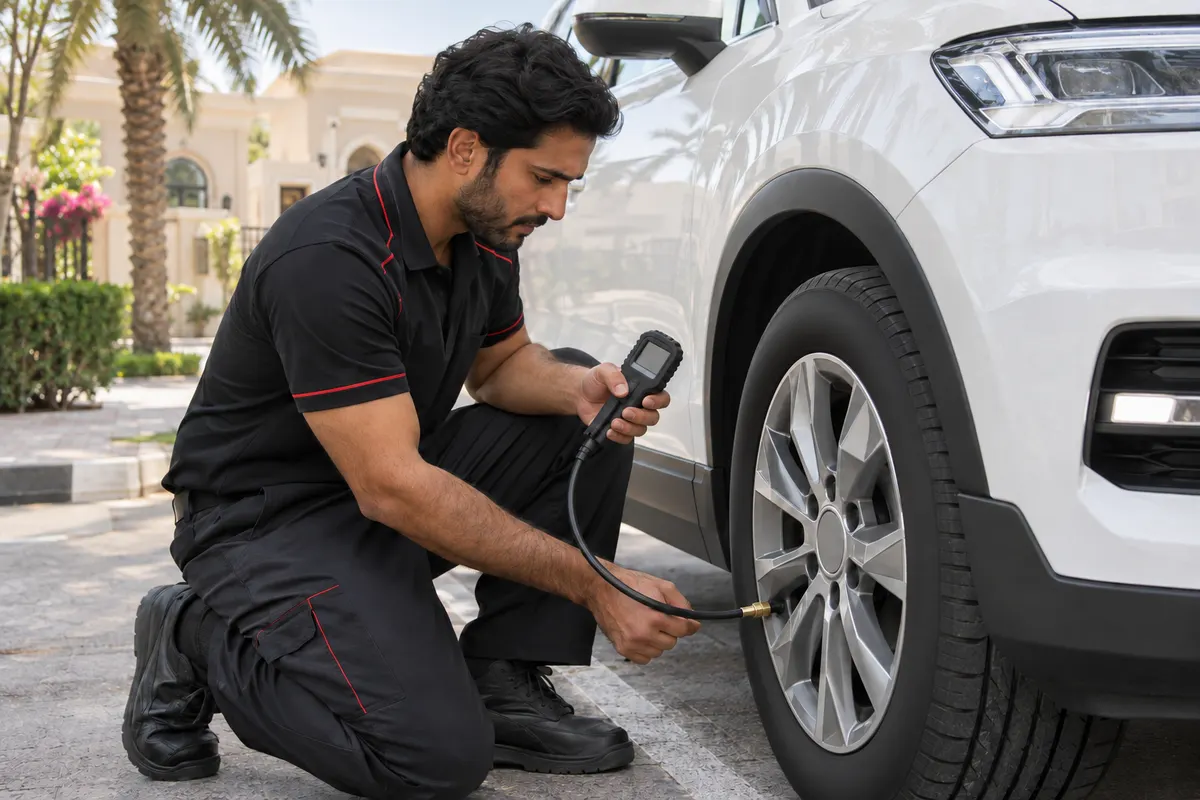
A good digital gauge costs very little and is more reliable than many petrol station gauges. If you prefer a technician to do it, we check all tyres including the spare, top up with nitrogen or air and tell you honestly if anything else needs attention. Correct pressure is also one of the biggest factors in how long Bridgestone tyres last in the UAE.